Showing posts with label scrivener. Show all posts

Monday, January 20, 2014

Day 20: PC Programs of Note

I feel as if I've done this post before, yet can't seem to find it. With that being the case, looks like I get a freebie!

Here are some totally rad computer programs everyone should have!

1. Dropbox. I mentioned this one in my writers post. What it is, simply put, is a shared folder. You create an account an you can store your files on the Dropbox website, to be accessed anywhere. That's pretty unoriginal. Dropbox is expanded upon by its downloadable app/program that allows you to have a folder on your computer (or tablet/phone) that you interact with as you would any other folder, but it is always linked to the web-folder. Now you can simply drag and drop your items into the folder, arrange them whenever and however, and you never have to log in again. Also, you can download this app to many devices and, after logging in with your account, these become copies of that folder. When you update one, all the others update immediately (assuming they are connected to the internet).

I use this mainly for my story writing. With the folder accessible at every computer I normally sit at, I have unlimited access to my documents that I sometimes want to edit or look over on the fly. Can't edit via my iPhone, but I still find uses there -- I upload a list of comics I'm looking for when I'm heading to a shop. There are also sharing features where you can create a "shared" folder in your Dropbox. This allows you to share certain files without having to give access to your personal account. I have one shared folder for my D&D crew -- now we all have access to character sheets and whatnot. If someone forgets their stuff or laptop (which they always do), it's a simple matter to look up/share a computer.

Also, Dropbox just added this thing where it saves screenshots (the thing that happens when you press the Print Screen button) automatically. This makes it MUCH easier than having to paste it somewhere, especially when you're trying to take a screencap of your awesome desktop to post later in a blog post...

Cost: Dropbox is completely free, unless you decide on more space than their starting amount. I haven't and more than likely won't.

2. Scrivener. I also mentioned this last time. It is a program for writers/authors that excels in document management, formatting, and creating unique elements such as timelines pulled directly from your content. If you're not sure exactly what that means, take a look at this video :


As I said, I don't own it, but I eventually plan to. I can see it being incredibly helpful for longer works. It's basically a word processor with ALL the bells and whistles that I always find myself wanting without jumping through 20 hoops and applications.

Cost: Scrivener costs $40. This is why I don't have it yet, though I did play around with the free trial a bit.

3. DisplayFusion. If you use multiple monitors, DisplayFusion (or a similar program of your choice) is a must. I enjoy DF's interface out of the few that I've tried. It allows me to seamlessly add additional monitors, each with their own settings. This can be as simple as maintaining separate wallpapers to how your screens line up (none of mine are the same size, so this is a pretty useful addition).

Cost: I have no idea what the cost of the Pro program is. I used the trial to get my setup going and haven't had any issues since. Pro has more options, but the basic is all you need to get functioning.

4. Rainmeter. If you want a truly custom desktop experience, Rainmeter is what you need. It allows for custom, user-generated content to be added to your desktop. This can take any shape or form imaginable, and has a decent number of contributors -- I've got a slew of different styles for free from the good folks over at DeviantArt.
My current desktop. It changed fairly often, thanks to Rainmeter.

I personally enjoy Fallout a good deal, so making my desktop look like a Fallout PC Terminal was too good to pass up... It's bland looking, but that's what I like about it. There are many beautiful options available as well.

Cost: Free and completely awesome. Takes a bit of getting used to, but is simple to modify after that. And you can mix and match parts from different creations, you're by no means restricted.

5. Start Menu X. Going one step beyond what Rainmeter allows, Start Menu X lets you modify... well... your Start Menu.

I know there are ways to change the icon of the Start Menu, but I haven't done that yet. What I've found most useful is the ability to create folders and sub-groups in the start menu, and the initial custom layout is much more appealing than Windows' standard fare.

Cost: Another deal where Pro gets you more, but free is enough for me.


Anyone else out there use something else interesting/useful? Share your programs so they can all be mine! ... Please?

Friday, January 17, 2014

Day... 16? Damn: Writer's Writing (of Words and Wonders)

Why does this month have so many damn days!

Whelp. I guess I'll talk a little bit about me and my writing style, I suppose. And I mean real writing, not this blog where I've been known to phone it in from time to time...

I enjoy reading science/speculative fiction and fantasy. Normally, that's also what I write. The book I've been working on most, mostly due to using it as my final project for my Creative Writing Master's, is actually a Young Adult Historical Fiction. I don't suppose that I'll only right YA, and it is unlikely I'll ever try historical fiction beyond this series either, but I've enjoyed branching out and find having to do so much research refreshing. Well, refreshing and somewhat frustrating due to not always finding the sources I'd like for my novel set in Japan during the late 1600s...

Trying to come up with authentic names is murder.
When I write, I generally have to set a schedule for myself. During the course of a day I may jot down notes related to any of the stories I'm working on, or even passages for works I don't KNOW I'm working on, but I can't get into actually writing unless I've set time aside for it and am relatively undisturbed. I don't schedule this in as often as I should, and I've got plenty of excuses as to why not -- every (poor) writer knows them, so I'll omit them for now.

Ever since I was a kid, I always imagined fantastic worlds or events. I assume I wasn't particular happy with what I was given and the books I was always reading offered so much more -- it is natural, then, that my imagination would bend in that direction. Putting these ideas on to the page, while difficult, has simply felt right. I won't say therapeutic, because my life has turned out pretty decently thus far, but these stories are always in the back of my mind and it is refreshing to clear up some space.

I have never been published. I've never completed something to the extent that I felt it was publishable. My current project, the YA novel, is the farthest I've ever come, and it is only just now starting the second draft/revision stage. So the tips I'm about to list should be taken with a grain of salt. Sure, I have an English BA and a Creative Writing MFA, but I've yet to get to the stage where all of these tips have proven their worth.

But read 'em anyways, because I said so.

My professional suggestions for potential authors (or writers of any kind, really):

1. Set no less than an hour a day for writing, and try to do it at the same time every day. If you do this, you will quickly get into the habit and writing will become easier for you. This is the hardest hurdle for me to get over since moving back to MA. Hopefully my schedule is solid now and I can start planning better, but we'll see.
1a. If you're worried about writer's block, don't be. Write about whatever. The act of writing will be your exercise, allowing you to build the appropriate muscles to beat the crap out of any blocks that hold you up. Also, it's entirely possible you'll find something useful in your daily exercises. I've found using prompts helps in that regards.

2. Only work on a single project at a given time (I suppose this one is more for novel/story writers). If a great idea pops up for your Steampunk/Private Detective novel, jot it down somewhere you'll remember it and then turn back to what you've been working on. This is the only way to finish a book, in my opinion. Otherwise you'll get caught up in the "creation" stage forever. This is almost like the "honeymoon" stage in relationships and, while it's great, it doesn't make a complete story (or relationship, to continue the metaphor).

3. Even if you're not sure where your story is going to wind up or the exact path it should take, keep writing! Even if it seems random or not always perfect, it doesn't need to be solid through the first draft. As you write more, you'll learn more about the characters, the world, and the relationships between. Then, when you are going for your next draft, you'll be that much more informed. You'll know what to cut, you'll have an idea of what imagery you should populate throughout, and you can keep an eye on character relationships to make sure they're heading where you need them to.
3a. Write on until you reach the end of the book. Do NOT revise midway through or try to keep every single thing coherent the first time through -- you'll never finish because something new WILL pop up. If a major character shows up for the first time towards the end of the book, that's fine -- you can work them in on the next draft.

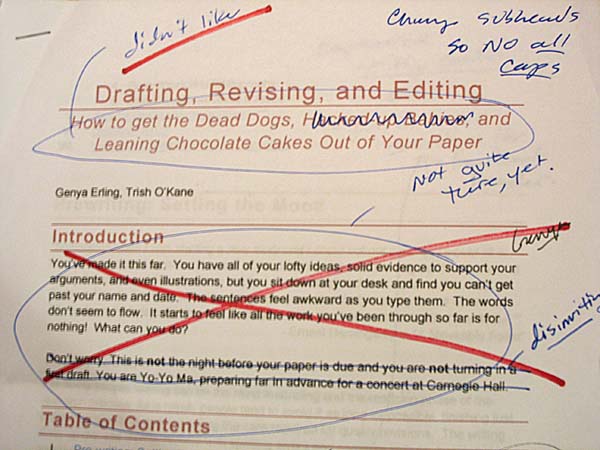
4. It WILL take multiple drafts before your story ever approaches completion. Also, your story will more than likely never FEEL complete -- you'll have to use your best judgement. Then get someone else's opinion.
Love the smell of giant, red x's in the morning...

5. Speaking of other opinions, it is incredibly helpful if you can get into/find a workshop with other writers. You can have your work read and suggestions made from like-minded individuals, and you'll grow as a writer when you start doing the same for others. Both of my degrees gave me a decent amount of workshops as classes. There are, however, local workshops or online workshops you can find that are not affiliated with a school. You could also create a group yourself, if you know enough readers/writers.

6. Read relevant material to your current project, but not to the exclusion of everything else. You don't want to be a direct copy of your favorite author, you'll need to be your own writer. We generally develop out own styles as a mix of many others. I've been getting inspired via Lovecraft for my eventual Steampunk/Private Detective novel, but I don't plan on making it a horror story, or feature any monsters.

7. Don't give up! Even if you eventually realize the work you've been doing for the better part of a year isn't going to be what you expected or be successful, use what you've learned for your next story/project. Keep an eye out where you can possibly salvage scenes or characters or locations or themes from your now-defunct story. There's always a kernel of good when you write, even if you don't see it initially.

8. Don't be afraid to start over. Many novels started out in the first person, only to be changed after several drafts. It's a lot of work to change something like that, but it isn't impossible. Even if the story isn't working in general, you can always try again. Maybe the main character is wrong, drawing the wrong focus from then reader. Possible you need to add or remove characters. Don't be afraid to butcher your work.
8b. DO make copies of your work, and save them separately before each major edit. You don't want to change your 1st person novel completely through, only to realize it worked better in 1st and not have a copy of the original manuscript.

9. Use technology to your advantage.
It's my file and I want it now!
9a. For storage and easy access, I use Dropbox for all of my stories. Then I can access it anytime from the internet, made even faster if you're able to download the application on multiple computers -- I have my folder on my computer, The Wife's laptop, my work computer, and several more locations.
9b. I don't want to pay for it so haven't yet, but Scrivener is something I will eventually pick up. It allows you to break up your work creatively, formats it however you'd like, and allows for very clear note-taking, timeline creating, and more. I'm a bit too cheap to drop $40 on it at the moment, but even the demo seemed as if it is the perfect writer's tool, no matter what you're writing.

10. Ask for help. If you need suggestions, you don't have to find all of them inside your own skull. You can ask friends, family, other authors, or even strangers for an opinion, thought, or preference. You can also do something as simple as people-watch at your local mall. Folks are always doing interesting things when they don't imagine they're being watched. Sure, that s
ounds a bit creepy, but I'm not telling you to go on Safari -- stake out in the cafeteria and just watch the tables around you. Have a notebook to jot down interesting tidbits of conversation or examples of unique characters. You don't have to use these notes, but they can be a fresh source of inspiration you won't get by sitting in front of your computer screen, idly pressing the space bar, hoping something brilliant will spring from your tired mind.

11. Do your research before blindly sending out your work to be published. There is a lot more that goes in in book publishing than any layman realizes, and it is a terrible, cruel, sanity-curdling beast if you aren't prepared. And it's just crappy when you are. So do your research and don't lose hope -- a rejection isn't the end of your creative career, it's part of the process.

Alright, that's all I've got for right now. Down the line, when I'm struggling with posts, I'll possibly post some prompts for potential writers out there. Keep an eye out for the "Writing Prompt" label.

Happy writing.